Alienum phaedrum torquatos nec eu, vis detraxit periculis ex, nihil expetendis in mei. Mei an pericula euripidis, hinc partem.

History of Haiti

At Risk Children Foundation / History of Haiti

Haiti: A Tradition of Solidarity.
On January 1, 1804, for the first and only time in history, a large group of slaves defeated the powerful Army of Napoleon and founded a new nation. However, the contribution of Haiti to the struggle against slavery and colonialism has just begun.

Aid to the U.S. Struggle for Independence from England.
In 1773, about 1,500 mulattoes led Count Charles Henry d’Estaing went to the U.S. (Savannah, Georgia) to fight for the independence of this country. Among the volunteers was the young Henri Christophe, who became one of Haiti’s independence heroes.

Aid to Dominican Struggle against Spanish colonialism.
In 1808. Alexandre Petion and Henri Christophe sent food and financial aid to Dominican patriots Juan Suanchez and Cyriaco Ramirez leading the fight against Spanish colonialism.

Aid to the South America Struggle against Spanish Colonialism.
In early 1816, Simon Bolivar came to Haiti looking for support. From President Alexandre Petion he received extensive military supplies, 1400 volunteers, a printing press, money, and food. These contributions were the most significant Bolivar ever received.

Aid to Mexico’s struggle Against Spanish Colonialism.
On October 1816, on request from Mexican General Francisco Javier Mina, volunteers were sent to fight against the Spaniards.

Aid to the Greek Struggle against Turkish Occupation.
In 1821, when Papflessas was calling for Greeks to rebel, some patriots, among them Wogorody Polichron aides and Clonares, obtained arms and volunteers from Haiti. Led by Panyottie, they landed on the island of Idhra to fight. Turkish occupies. In 1935, Princess Marina of Greece visited Haiti to express her country’s gratitude for Haiti’s contribution to the struggle against Turkish domination.

Aid to the Belgian Struggle for Independence.
In 1830, Belgian revolutionaries received the support of the Haitian government in their struggle for independence. After victory, the Belgian adopted Haiti’s national motto “In Unity There Is Strength.”

Haiti: A Tradition of Solidarity.
On January 1, 1804, for the first and only time in history, a large group of slaves defeated the powerful Army of Napoleon and founded a new nation. However, the contribution of Haiti to the struggle against slavery and colonialism has just begun.

Aid to the U.S. Struggle for Independence from England
In 1773, about 1,500 mulattoes led Count Charles Henry d’Estaing went to the U.S. (Savannah, Georgia) to fight for the independence of this country. Among the volunteers was the young Henri Christophe, who became one of Haiti’s independence heroes.

Aid to Dominican Struggle against Spanish colonialism
In 1808. Alexandre Petion and Henri Christophe sent food and financial aid to Dominican patriots Juan Suanchez and Cyriaco Ramirez leading the fight against Spanish colonialism.

Aid to the South America Struggle against Spanish Colonialism.
In early 1816, Simon Bolivar came to Haiti looking for support. From President Alexandre Petion he received extensive military supplies, 1400 volunteers, a printing press, money, and food. These contributions were the most significant Bolivar ever received.

Aid to Mexico’s struggle Against Spanish Colonialism.
On October 1816, on request from Mexican General Francisco Javier Mina, volunteers were sent to fight against the Spaniards.

Aid to the Greek Struggle against Turkish Occupation.
In 1821, when Papflessas was calling for Greeks to rebel, some patriots, among them Wogorody Polichron aides and Clonares, obtained arms and volunteers from Haiti. Led by Panyottie, they landed on the island of Idhra to fight. Turkish occupies. In 1935, Princess Marina of Greece visited Haiti to express her country’s gratitude for Haiti’s contribution to the struggle against Turkish domination.

Aid to the Belgian Struggle for Independence.
In 1830, Belgian revolutionaries received the support of the Haitian government in their struggle for independence. After victory, the Belgian adopted Haiti’s national motto “In Unity There Is Strength.”


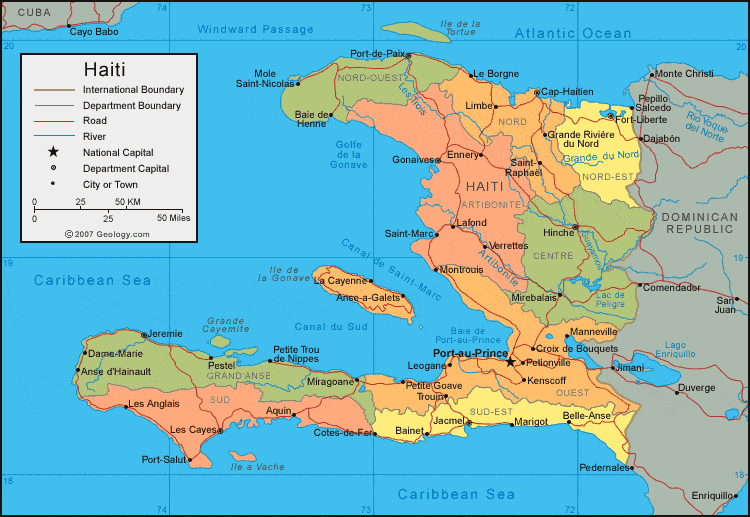
Haiti shares the island of Hispaniola with the Dominican Republic. It is a beautiful country but has a long and difficult history. As a French colony with hundreds of thousands of slaves, Haiti was one of the wealthiest countries in the Caribbean through the sugar and forestry industries and the importation of African slaves.

In 1804 after 500,000 slaves revolted, Haiti became the first Black Republic to declare independence. But years of exploitation, corruption, and natural disasters have turned Haiti into one of the poorest countries in the Caribbean.